A Search for Gold and The Beginning of a Community
When the Emerald Historical Society suggested I write a piece of drama to celebrate the 150th anniversary of gold discovery in the area, it meant a search for historical facts and anecdotes to create a dramatic impression of how it might have been. The digging for facts, because of time constraints, had to be alluvial or surface digging; even so, the result was a rich collection of information.
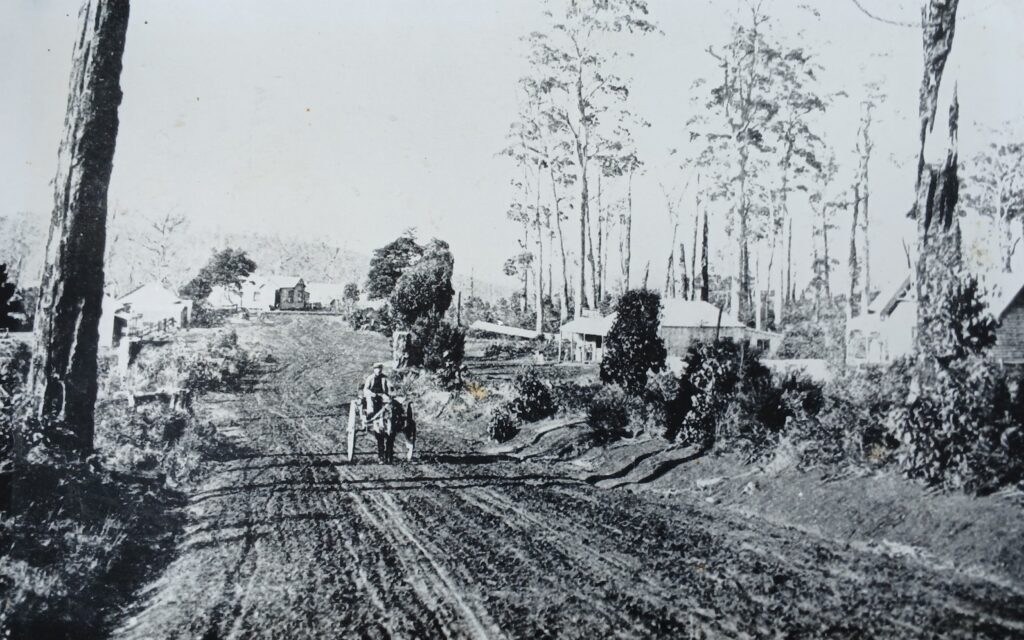
Main Street of Emerald circa 1900
The beginning: the conception
The official discovery of the Emerald diggings at the junction of the Worri Yallock and Emerald creeks in the Dandenong Ranges was recognised to have occurred in November/December of 1858. In 1860 the Victorian government offered ₤100 rewards to those people who could prove to be the discoverers of auriferous or payable goldfields.
In formalising the Emerald diggings discovery, a Victorian Government Select Committee, after hearing evidence from miners, an inspector of police and a district warden, issued the ₤100 rewards to six people: William McCrea, Patrick Geraghty, John Walsh, John McEvoy, Patrick O’Hannigan and Maurice O’Shannassy. But more than just a gold discovery occurred; it was the time and place when a community was conceived that would become the town known as Emerald the jewel in the hills.
When, as historians, we fossick for facts, we expect to discover what will sometimes be contradictory, confusing and inaccurate; and what we find will not always be facts but hearsay, folklore, or just good yarns. It’s part of the fascination of the search for an image of a time past. And so it was when we began to look for facts and information about the discovery of gold in the Dandenong Ranges.
It is a fact that gold diggings were established on the Emerald and Worri Yallock creeks and also the Menzies and Sassafras creeks; but exactly when, even those who were there couldn’t accurately recall. It is a fact that the gold seekers were encouraged to prospect the area by Peter Henry Smith, a Victorian inspector of police and Arthur Selwyn, a gifted Victorian geologist.
It is also a fact that in September1859 one square mile of land was marked out on a surveyor’s map as the site for a township and given the name Main Range. However, we found no definitive evidence of when it became known as Emerald: all we could dig up was folklore.
So where from its name?
It was reported in the Herald newspaper on 14 October 1851 that Germans first came to the junction of the Menzies and Woori Yallock creeks and found gold, then cashed it in to the tune of ₤2000 before going back to Germany; thanks very much! And it’s said that the German fortunes inspired a couple of Irishmen to come a specking and a fossicking in the Menzies Creek, which they called Monkey Dung Creek. What they named the creek after, were, in fact, wombat droppings. And it is said that the place reminded these Irishmen of home, so for the want of a name to register the place of their claims, they called it Emerald.
Yet another tale tells of the Reverend Dr John Bleasdale of St Francis’ Cathedral in Melbourne. He was a gemmologist, who, supposedly, found emeralds in the creek; but nobody can recall ever seeing him in the district.
And the favourite yarn, it seems, says Emerald was named after Jack Emerald, a prospector who lived in Monbulk, and who named the Emerald creek. They found him dead in his hut with a bullet though his heart, murdered, it is said, for his gold; but there are no official records of Jack or of his murder. It’s a good yarn, all the same!
However, it was in 1858-9 that people came in numbers to look for gold, encouraged by Selwyn and Smith. In his testimony at the Select Committee hearings Peter Henry Smith Inspector of Police says:
In the beginning of 1858, I went out to Dandenong Ranges, and I went through the country there, to see how many people were collected for the purpose of forming a police station, if necessary, amongst them, and I noticed there were very few people there, but I do not know their names. I then went to Ballarat and mentioned it to a number of Ballarat miners. I was anxious the place should be prospected, because I was of the opinion it was useless in every other respect, except for its mineral wealth; I though that it would be good to the country to have is prospected. I mentioned the matter to Mr McCrea, and in the latter end of the same year McCrea with one Big Pat and a man named Geraghty and one or two others went there.
The records of those Select Committee hearings in 1861-63 are an excellent primary resource but in those documents, we found many contradictions. One thing that was never contradicted, however, was the claim that the diggings were named the Emerald diggings by the miners. Could it be then, that the town simply got its name by association? Did the community that established itself on the Emerald diggings become known or referred to as those on the Emerald and to follow, Main Range on the surveyor’s map became Emerald?
A town’s people
A town, of course, is not a town without its people, its community. It’s the people that give a place its distinctive character. Even though the gold diggers came to the area for selfish reasons, a community did develop from their presence, and apart from the six diggers recognised as those who came first, others such as George Hunt, William Watson, William Stuart, and William Kilpatrick are just some of the names of men who are known to have come to try their luck. Others came too to trade with those who were digging.
According to John Walsh, one of those first miners;
“The next party that arrived and put up stores was a man of the name of Gardiner, Mr Davis who keeps the Dandenong pound, and Mr Rogers. He’s not living.”
It’s also known that the Kirkpatrick’s ran a store, William was a butcher and a blacksmith; and their store was used as a police station for first year of the diggings. Then the bullockies came to supply those traders. On tracks that could take no more than a dray, the bullock teams of Tom Charman and Dan Kennedy carried supplies to the diggings when the terrain was almost impenetrable.
The women and children came too, and children were born on the diggings. Some secondary sources say that upon checking burial records there were at least three babies recorded to have been born on the diggings in 1859 and they were: Anna, Sarah Tyrell and her sister Susannah, Jane, and Bridget Canney. Yet another secondary source says that the first white baby born at the Emerald diggings was a girl named Emerald to the Watsons’ and she was born in 1861; and the first boy was James, born to William and Mary Stuart, also in 1861.
Who were the miners?
But who were those first miners who came and caused the community to be born? Why did they come to the Dandenong Ranges, at a time when the bush was so dense and almost too difficult to penetrate? The ‘who, what where, when, and why’ of history are the basic questions we ask as historians. Who were these people and why did they do what they did when they did it? It is often the fun part, trying put faces to names to discover or reconstruct the people from the facts and anecdotes we gather. As eminent historian Manning Clark once said, it is like putting the flesh back on the bones of history.
When we read the testimonies in the Select Committee Hearings, we can hear the voices of some of those who were the first to come to the area to discover gold and subsequently to name the goldfields. The miners told us where they went, down to the exact spot, the junction of Emerald and Worri Yallock Creeks and the surrounding district. They told us they went to find gold, finding it first on that part of the Emerald Diggings known as Macclesfield; and why they went there was because it was what they chose to do for a living; they were seekers of gold.
But things are never as clear and neat as that. Faces to names are formed from the motivations for what they said and did and the deeper reasons why. The best clues for us were in what they said in the Select Committee hearings.
In the testimonies of McCrea, Geraghty, Walsh, McEvoy, and O’Hannagan there is no one view of that time past, of what was to become Emerald history. The accounts of those men have been coloured to suit their individual aims and objectives; that much is clear. When one testimony is compared to another and then put alongside the testimonies of those government administrators they dealt with, relationships and motivations become evident; and whilst it soon becomes obvious that the truth was being shaped to favour each claim to the committee, much is also revealed about the personalities. Of the six men there are three stand-out characters; William McCrea, Patrick O’Hannigan, and Patrick Geraghty; although, that is not to say that the other three weren’t stand-out characters only that they were less revealing in their testimonies.
William McCrea
Peter Henry Smith introduced us to William McCrea when he referred to the reasons why he told him about the possibilities of gold in the Dandenong Ranges:
… and I may mention the reason why I told him to go: at the time that I was in charge of the Ballarat district, after the Ballarat riots, those men and a number of others, Mr Frazer, Mr. Gillies, and John Yates and others, rendered me a great deal of assistance in those days in putting down crime, and McCrea among them; I felt grateful to the Ballarat people for their assistance, and any of them that I could assist in giving them information about gold-fields, in going through the colony, I used to do so; I mentioned it to him and suggested he should take a party and prospect those gold-fields, never looking at any reward; I do not know that there was anything about in the way of reward at that time.
In that paragraph of evidence, we can deduce that William McCrea had been on the Ballarat goldfields around the time of the Eureka riots and that he was not only respected by the police but had earned the loyalty of this inspector who also went on to describe McCrea as the best bushman in the place. To add to McCrea’s apparent respectability in the eyes of the police, his mining mates testified that at the public meeting held to name the diggings, he, being a magistrate, was elected chairman of that meeting; and so, we can reasonably assume he was respected, in a similar sense, by them too.
District warden, Warburton Carr said that he knew McCrea from a number of other goldfields whilst McCrea, himself, told of his bushman’s association with the gifted geologist Arthur Selwyn. It’s then reasonable to assume he was not just someone who had bought a pick and shovel to go and look for gold on a whim. Warburton Carr said of McCrea that at that time when he was obliged to put O’Hannigan in irons it was McCrea who “…offered to assist me to preserve order…”
McCrea then, comes across to us as a well-respected citizen with qualities of forthrightness and leadership.
Patrick O’Hannigan
Any good story has its bad guy and Patrick O’Hannigan quickly put his hand up for that role. The testimonies tell us he was a big man and a bully. Walsh described him as; “…a very wicked man, and he would have everything his own way, there was no living with him anyways…” P. H. Smith, the Inspector of Police, testified that O’Hannigan had many miners in fear of him, saying;
…I may say this man Pat was a very demonstrative character and seemed to rule everybody then, physically, he was a very quarrelsome man, and we had a great deal to do to keep him in order, and many people, I believe, gave way to him because they were afraid of him.
O’Hannigan got in dispute with Geraghty over a quartz reef claim, both claiming ownership; and in dispute with everyone when he set up a claim below the others and dammed the creek.
There is much said about Big Pat O’Hannigan in Select Committee hearings from all who gave evidence. Consistently, they all describe him as big, volatile, selfish and manipulative. In contrast to McCrea and others, O’Hannigan gave evidence to the committee that he was the sole discoverer of gold on the Emerald Diggings claiming he was in the district long before any of the others came near.
So, to us it became clear that Big Pat O’Hannigan was by no means a socialite. He struggled to maintain close friendships because it was his way or no way.
Patrick Geraghty
Warburton Carr said in his testimony that: “Geraghty was well known to me. He lived at Anderson’s Creek and was always mixing himself up with any party that were prospecting, and at the moment he heard of anything of a new goldfield he was sure to go and have a finger in the arrangement…” From this statement we can begin to think that Patrick Geraghty was at least an opportunist.
William McCrea does not display any kind of mateship or affection for Geraghty as highlighted when Mr McCann of the Select Committee put it to him that: You said just now you had nothing to do with Geraghty because he was dishonest? McCrea replied; “We never had any gold dealings except sending the prospect to town by him.” When asked if Geraghty was one of his mates, McCrea answered; “Only as one of the prospecting party.”
Walsh told the committee that he had met Geraghty coming down from the ranges and that he had arranged to meet up with him later to go looking for gold, So could it have been that Geraghty and McCrea were rivals for leadership of the group that came together in the splitters hut in Dandenong on their way to the ranges? We can only speculate about the picture it portrays with the added complication of Big Pat O’Hannigan demanding his own way in the middle.
Mining in the district was not easy and sometimes took a toll on those prospecting; and Patrick Geraghty told us how hard mining was in the Ranges. When asked by the committee if he was still mining, he said; “No. I laid the foundations of my ill health in the mountains, and I have not been there in the last two and a half years.” After his gold mining days were over Patrick Geraghty went to Kew, a suburb of Melbourne to run a public house.
Who were those who were not miners?
We gathered our information about the discoverers of gold from that one primary source, and it is not possible to form detailed or accurate conclusions about their characters, merely cameos. Even so they are cameos derived from the voices of the people themselves. The images of other people who came to the diggings around the time of 1859, such as those who follow, were taken from secondary sources; that is, other historians who have, maybe, dug deep to find information and form opinions from a variety of sources.
William Stuart
William Stuart was a champion buck-jump rider and had been a member of the police force, engaged in breaking in police horses before he joined the trek to the Emerald Diggings. He married Mary Kirkpatrick and for about ten years after the gold rush William Stuart was engaged in transporting horses to India, for re-mount.
Mary Stuart nee Kirkpatrick
Mary Stuart was born in Melbourne in 1840 and married William Stuart after meeting him on the diggings, we think. Her son James was claimed to be the second white child born on the diggings and the first boy, in 1861. In 1899 Mary secured the title to 19 acres embracing the site of the Emerald diggings and conducted a store on the property for many years, even after her husband died. She died aged 87.
The Kirkpatrick Family
William Kirkpatrick came to the diggings in 1859 with his wife and children, he conducted a store at the emerald diggings, in addition to which he was a blacksmith and a butcher.
The Watson Family
The Watson family came to the diggings with seven daughters and two sons. Emerald Watson being said to be the first white baby to be born on the diggings.
Actual or folklore?
Then there are other people unearthed in our digging who appear somewhere between truth and folklore. They left us wondering had we found fool’s gold, the clarity of their stories falling somewhere between exact and exaggeration.
Our initial research revealed, in an anecdote, the sad circumstances of young Dick Hinton who died on the Emerald when his mine shaft collapsed on him on the day he was to be married. But further research revealed nothing more about Dick. Then exactly the same story but of Andrew and Amy was unearthed in the writings of Mary Skinner recounting life on the Ovens goldfields. Miners on every field died when their shafts collapsed on them. So, was Dick’s story a romantic tragedy that did happen once, somewhere, and then drifted from place to place, carried on the backs of the story tellers? Maybe, maybe not, maybe he did die on the Emerald as it was said; but it reminded us how things seeded in truth can become the truth with the telling and retelling over time and in different places.
Contradictions
When a number of people recall a particular time or event, they see it through their eyes and with their own biases and beliefs attached. So, in historical research, it is not unusual to have contradictory accounts of the same happening from those who were there. Added to that, when it is expedient to shape the truth for personal, political or economic gain, very different pictures of the same event can be and are often created with absolute certainty.
McCrea told the Select Committee that the first gold discoveries were made by Walsh and McEvoy as members of the group of mates. Warburton Carr gave evidence that O’Hannigan was the first to come to him with the claim that he alone had found the gold. Smith, the Inspector of Police testified that he encouraged McCrea to go to the district at a time when no gold was being sought and McCrea said he and Selwyn the geologist crawled on hands and knees to penetrate the area before it had been opened up to prospecting. Yet in a letter to the committee from Richard Ireland, the Victorian Attorney General, it is said that O’Hannigan was in the district long before the others. When asked at his hearing appearance, O’Hannigan claimed that he went to the Dandenong Ranges in September – October 1859, but he was less than convincing when asked if he was sure;
283. 1859? – No, the year previous; but I discovered the Emerald Diggings in the year following on the month of January.”
284. What year? – The year following 1860,
285. The year 1860? – Yes.
286. Are you sure? – I’m not exactly sure exactly when I got into the ranges first I was several months before I found the Emerald Diggings.
Even though he was indecisive, even confused, at times, it seems, O’Hannigan had played the politics well and had the Attorney General, no less, speaking up for him. This is not to say the Attorney General was lying; O’Hannigan had given him information and a petition, to back up his claims, which Ireland was merely responding to.
Each of the miners, in turn, told the committee that they were there together as a group of mates, yet gave different dates or varied accounts of life on the diggings. Geraghty testified that at the time of a public meeting on the dray; “…O’Hannigan was not at the meeting at all, he was sick in bed, and I put a mustard poultice to his side when I was coming down to the meeting.” Here emerges important differences of opinion, a shaping of the truth. O’Hannigan said that the meeting was called to recognise him as the discoverer of the goldfields at which the petition was signed, to name him as such. Others testified that the meeting was called to name the diggings, except for Walsh who said he knew of no meeting taking place.
Consider the petition, with 2000 signatures, submitted to the Attorney General by O’Hannigan. The estimates of people on the Emerald diggings, at that time, were never beyond 600 people and that number waxed and waned as the diggings flourished, became deserted, and then flourished again over that three-year period.
There were never, it is said, ever 2000 people on the Emerald diggings. Warburton Carr testified that he believed O’Hannigan got his petition up at Kew near Melbourne at the public house kept by Geraghty. Warburton Carr surmised that O’Hannigan would have dropped his partition on the table and miners coming and going would have signed it without much persuasion. And yet another contradiction; why would Geraghty allow O’Hannigan to use his public house to get up a petition to support a gold discovery reward that didn’t include Geraghty himself; and not forgetting they had been in dispute over a quartz reef of which they both claimed ownership?
Eureka Connections
As we fossicked for facts we also began to see how closely connected the goldmining Victorians were. The Inspector of Police, as has already been said, had been at Ballarat at the time of the Eureka riots and had established a relationship with those miners who he had then encouraged to mine on the Emerald. McCrea was one of those miners. There was also a William McCrae who was licensee of the Star Hotel where the Eureka miners went to plan and plot. That William McCrae, spelt slightly different, told the police that one of the miners, Captain Ross, was in his hotel dying after the rebellion. But whether it is the same McCrae/McCrea we were not able to find out in our alluvial digging. And there is yet another link to Ballarat and the Eureka rebellion. Patrick O’Hannigan sent his partition of two thousand signatures to Attorney General Richard D Ireland who had impressively and successively represented Eureka miners charged with treason after the Eureka Rebellion. Did O’Hannigan know Ireland from Ballarat? Maybe.
One last nugget
Whilst our fact finding has been alluvial or surface digging, things continue to be revealed, and the urge is to go deeper. It takes some discipline to stop and put down the pick and shovel. Yet as we came to the end of our shallow digging and sluicing for facts, one last nugget was uncovered in the first edition of the Yarra Valley Historical. A page is dedicated to ‘Big Pat Creek’. So, the big bloke with the bad temper has a place named after him. The Historical also said that Big Pat went back to his claim on the Emerald in March 1863 and in a drunken fit of depression hung himself from the ridgepole of his hut at the age of 37.
For those who come after us, and given the time to dig deep, who knows what more nuggets could be found for a clearer or more vivid picture of a time and a place past, known as Emerald the Jewel in the Hills?
References
Books Emerald specific:
Flett, James, The History of Gold Discovery in Victoria Poppet Head Press, Melbourne, 1979
Miller, Jan, & Buckland, Isobel, Miner Details: A collection of facts pertaining to the mining history of Upper Yarra, Published by the authors, 1982 updated in 1988: viewed in Emerald Historical Museum.
Coulson, Helen, Story of the Dandenongs1838-1958, F.W. Cheshire, 1959
Newspapers:
Yarra Valley Historical Vol 1, issue 1; p.26
Victorian Government documents:
Victorian Parliamentary Papers, Select Committee minutes of evidence 1861 -63
Books general:
Skinner, Emily, Woman on the Goldfields,
McDougall, Cora, (editor), Gold! Gold! Diary of Claus Gronn A Dane on the Diggings, Hill of Content Publishing, Melbourne, 1981