The ETU and the Cole Royal Commission
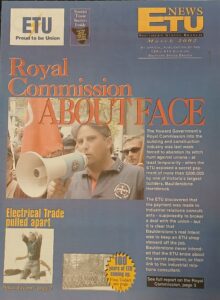
A Unionist View of the Royal Commission into the Building Industry.
- ACTU Australian Council of Trade Unions
- CFMEU Construction Forestry Mining Engineering Union
- ETU Electrical Trades Union
- HIH HIH Insurance Company
- HWT Herald and Weekly Times newspapers
- NECA National Electrical Contractors Association
Although the Royal Commission into the Building Industry began in 2001 and concluded in 2003, it’s investigations unfolded mostly in 2002 and the following essay is an account of the observations and experiences of me, a rank and file electrical trades’ unionist who followed the events, talked to people involved and formed a view of my own relative to my own union’s involvement.
Of the thousands and thousands of hours of hearing, only a perception of the truth can be gleaned and that biased from the platform on which I stand. My platform is that of a worker not involved in the building industry but in manufacturing where the relationship between worker, union and employer is very different to that in the construction industry. However, unashamedly my sympathies are with the building workers and my union. Because I want the essay to contain a social commentary, I have included in it my feelings and opinions and those of others as they surfaced or were incited and as I perceived them to be.
In the year of 2001 an ABC Four Corners program titled Divided We Fall ran a story about the political infighting of the CFMEU. In it, John Sutton, the Federal Secretary of the Construction Division, and Kevin Reynolds, the Western Australian Secretary, were trying to destroy each other.[1]
Sutton appeared on the screen saying, of Reynolds, ‘He’s a leading light in the Labor Party and feared by politicians,’ and ‘… into intimidatory tactics and will use enforcers… and all kinds of unethical methods.’ In reply, Kevin Reynolds opened his account by saying; ‘He says he’s supposed to be the National Leader of our Union and yet he’s shit frightened to go to an election of the rank and file.’[2]
The program interviewed leading officials from Victoria. Martin Kingham, the Secretary of the Victorian Branch of the CFMEU said, ‘The only corruption was in John Sutton’s New South Wales’. John Cummins, the Victorian Branch President added, ‘If the members get their say, John will be very much a dead duck.’ Sutton made accusations of violence and intimidation by Tom Domican, a self confessed political thug in the NSW Right, who also appeared on the television screen, in half shadow, looking menacingly into the camera and saying; ‘Bring forward the proof John… where I have stood over anyone in New south Wales… you’re a scared rat!’[3]
It is not hard to imagine Tony Abbott, the Liberal Government’s Workplace Relations Minister and anti- unionist, as I see him, salivating in front of his television screen while these unionists, and a political thug, strut their stuff for the cameras. And it was not really a surprise when, in July 2001, the Liberal Government announced its intent to form a royal commission to investigate corruption and intimidation, not only into the CFMEU but within the building industry nationally. ‘It’s a witch-hunt’ claimed the unions while the media were asking if it was to do with the upcoming federal election.[4]
To some of us, it seemed to be the Liberal Government cashing in on an opportunity to dig for dirt in all those unions within the building industry: an excuse to investigate where there had not been any just cause to do so. When this government is considered neo-conservative or New Right, then it is to be expected that it would search every avenue in its ideological quest to destroy, if not the principle of unionism, then the abilities of it.
The newly set up Building Industry Royal Commission was given three main terms of reference to inquire about and report on:
- Any unlawful or inappropriate practices.
- The effects of those unlawful and inappropriate practices.
- To take into account any legislative and administrative changes that could be made to improve on the unlawful and inappropriate practices.[5]
A retired barrister, Mr Terrence Cole, QC was appointed Commissioner of this Royal Commission, given sixty million dollars and a legal team including Richard Tracey, QC, as chief prosecutor, go and investigate and sit in judgement on those in the building industry.
On the first day of the hearings Commissioner Cole issued a direction that only those who co-operated with the Royal Commission would be given leave to appear. A union QC denounced that direction as ‘Stalinist’ and Cole would later withdraw the direction.[6] It was hardly the start to instil confidence in ‘a fair go’.
On 24 December 2001 Tony Abbott wrote to business giant Multiplex Constructions providing, as The Age described it, ‘a letter of comfort’. The letter was used to convince English newspapers The Guardian and Evening Standard that Multiplex was not under specific scrutiny for “improper and illegal activity” at the time when it had just won a contract to redevelop Wembley Stadium in England.[7] In part, the Minister’s letter reassured Muliplex’s John Corcoran that, ‘…the Cole Royal Commission is not enquiring into any particular company. ‘…A key focus of the Royal Commission is the “closed shop” which generally operates in the industry and rorts, rackets and rip-offs arising from breaches of freedom of association principles. It is not a “Fraud Commission” …’[8] In the opinion of unionists, at least, this was conformation, if it was ever needed, that the intent of this Commission was to be an attack on unions.
On 6 February 2002, the Electrical Trades Union of Victoria was asked to appear before the Royal Commission’s court for the first time. The opinions of electrical trades’ unionists, like me, were that the union would be guilty until proven innocent. ETU State Secretary, Dean Mighell was summoned on this day and unionists of all persuasions gathered at the base of the Collins Street Towers in Melbourne where the Royal Commission was based.
Reporters and others waited and watched as a CFMEU shop Steward, with a loud hailer, appeared wearing a green hard hat. The loud hailer lieutenant stood on the small wall surrounding a water feature, at the entrance of the shopping arcade, ready to begin what was already becoming a ritual at the start of any Commission hearing day that included appearances by unionists. The unionists gathered around ‘Green Hat’ as he yelled into the loud hailer; ‘We’ve come here today in support of our comrade, Dean Mighell!’ The unionists cheered. ‘Come on! Raise your fists in the air!’ and the unionists, or at least most of them, followed his lead. The mob then echoed whatever ‘Green Hat’ yelled:
‘Boggy Commission, shove it up your arse!’
‘Boggy Commission shove it up your arse!’
‘Terry Cole, shove it up your arse!’
‘Terry Cole, shove it up your arse!’
‘E-T-U!’
‘E-T-U!’
Dean Mighell!’
‘Dean Mighell!’
And then the unionists began to chant while office workers and shoppers circled them warily, just as grazing animals circle a pride of hungry lions.
‘We’re angry! We’re loud! We’re union and we’re proud!’
‘We’re angry! We’re loud! We’re union and we’re proud!’
“We’re angry! We’re loud! We’re union and we’re proud!”
When the chants died down and the fists were lowered, the ETU secretary addressed the unionists with anticipated hyperbole and was given three rousing cheers. Then he and his closest supporters moved into the court through a union guard of honour. This organized show of unity and contempt for the Commission would occur every time any unionist was called to give evidence.
ETU unionists crammed into the lift, and it struggled on its way to the thirty second floor. It stopped halfway in its assent and became a confined space of amusement. But as we called for a rescue and filled the lift with fart jokes our union secretary stood silent, maybe even pensive, in the back corner. I recalled a previous conversation with him when he talked about times when being a union secretary can be the loneliest of times; when he alone has the future of the organisation on his shoulders and when, unless you are in that position, it is impossible for anyone else to understand the pressures of the moment. While we waited for the lift to restart its assent to the court, and the fart jokes filled the air, this was one of those moments. As the rest of the unionists tried to out-do each other in comedy, they were loyally oblivious to the contemplation of our union secretary.
The lift did finally finish its assent, unionists poured out of it and into the court and the moment of contemplation was over: the assault on the ETU would begin.
The courtroom was wide and characterless and blinds on the windows shut out the rest of the world. Five cameras, fastened to the ceiling, pointed at various areas of the court with the images they captured displayed on the walls in three places. The public area was closest to the entry of the court while rows of computer laden tables arced around the Commissioner’s Bench and the witness box. The unionists filled the public seating.
Commissioner Cole came out of a back room at 10:00am. Everyone stood until he sat and then proceedings began for the day. Along the back wall, a row of media television cameras pointed like rifles of a firing squad as the ETU Secretary took the stand and refused to give up his hard hat. It was time for the ETU to prove it could stand up to the scrutiny of Royal Commission investigations. This was not like a normal court of law, however, as there was no right to silence and yet any alligation could be made in the Commission with legal privilege, and often would be, and published. Witnesses could only be called by the Crown Prosecutors and only be cross-examined at the Court’s discretion. Unionists felt this was a court to be used as a forum for settling scores.
Richard Tracey QC, as senior council assisting the Commission, began by raising some anomalies of Enterprise Bargain Agreements. While the rotund, white haired Commissioner Cole sat looking like he had been dragged out of the Melbourne Club and told to sit and scowl at any unionists in the witness box, Tracey had an air of the supreme about him. His suit looked like it was the most expensive in the room and his persona was full of animation, raising and lowering of his voice, using calculated pauses, staring at the witness over the top of his glasses, asking questions of the witness while looking at the side wall. He was a performer whose craft was obviously to get the answer he wanted rather than the answer the witness wanted to give.
This day seemed to be an investigation into paperwork errors but given an air of the melodrama. In some cases, enterprise bargaining agreements struck between the union and employers had been unsigned by the National Electrical Contractors Association (NECA) and in other cases the dates had been altered, not by the ETU but by Ross Fern of NECA. As no agreement should be signed by anyone until it is read, it was purported that by association, the ETU was guilty as it should have seen these anomalies. This was not an accusation that there had been any impropriety in negotiations or agreement but that the ETU had signed the agreements without dates on them or where they had obviously been altered. It was also said that the Industrial Relations Commission had ratified them in the same way. It was an intense scrutiny of procedural anomalies. In the Commission’s eyes, so it seemed, all three parties were guilty.
The ETU secretary pointed out that, at times of EBA renewal there are thousands of agreements, all basically the same and to be signed and ratified at the same time. It is impossible to read every word of every agreement and that the irregularities were not caused by the union. Indeed, it was obvious to some of us that all Ross Fern was doing was trying to manage an administrative nightmare.
In the public gallery, Mike Symons, the union’s industrial officer for the ETUs Protect Severance scheme, shared his feelings: ‘They’re now wasting a lot of people’s time by saying, “You didn’t adhere to dispute resolution procedure in your enterprise agreement”. To me no-one should be spending $60 million to hear those sorts of stories!’[9]
But Mike didn’t believe it was the ETU or NECA the commission was after in this case:
Remember that the conservative government’s point of view is that they don’t want the IRC (Industrial Relations Commission) there; they want them out! They don’t want to have that as a tribunal or regulator of industrial relations; they want to have that put back into the civil courts. Obviously, once that sort of thing goes back into the civil courts it’s whoever’s got the deepest pockets wins… It’s a political ideology. They don’t want a third party involved… and they call union’s third parties.
They would much rather it went down the path of civil proceedings whereby, yes, the unions could run a few cases, but it would only take a few losses and there’d be no more union. And an individual would have absolutely no chance. An individual cannot afford to run a county court action against a multi-million dollar sized employer. You won’t lose, you will run out of money and then you will lose. It certainly hasn’t focused on the issue dearest to my heart, which is the blacklist…[10]
The blacklist Mike referred to is not a written list and to get on it is quite simple. “If your name’s on it,” says Mike, “it means you have been an activist; a shop steward, a safety rep who’s done his job and probably caused them some pain along the way… all it means, practically is that if you apply for a job, you won’t get it.” Those who get onto the blacklist need all the support their union can muster; and the blacklist and its ramifications would soon be exampled in the court.
By the afternoon Tracey was asking the union secretary what trusts the ETU had, were they correctly published and audited; how many boards of organisations was the union secretary on and how much money did he make from them? What was the salary of the ETU Secretary? Under this intense scrutiny, Deam Mighell was able to say that the trusts were published and audited and that any member of the Victorian Electrical Trades Union who is on a board earns nothing from it as he is working for the ETU and any money goes back to the union and is clearly accounted for. Although Tracey does not highlight the point the salary of the Union Secretary is minuscule compared to the executives he deals with and unlike those executives, he does not have any juicy performance bonuses or terminations payouts stitched in his contract.
The court demands the proof in writing. Dean Mighell makes the point that if it were an employer operating in the way the ETU did, the court would be praising it, yet because it is a union it is being condemned. The day finishes with the Union Secretary exhausted but the Union standing tall.
Following Commission investigations during the month of February, and maybe even before then, secret hearings were had about another matter concerning the ETU. The legal people representing the union would say that there had been a level of excitement at these behind closed doors, or closed hearings as they are preferred to be known. But, according to union officials, it had been a ‘balls-up!’ The focus on the union had been too intense, and wrong conclusions had apparently been drawn. In its investigations the Commission had uncovered a payment of a large sum of money to a company called ‘Pro-Tect’ and it had assumed Pro-Tect was the ‘Protect’ severance arm of the ETU and that the money was some sort of corrupt payment to further the union’s cause. This would fit nicely into the Commission’s terms of reference on unlawful or inappropriate practices.
Mike Symon reflected yet again;
It seems someone in the Commission thought, well, the ETU run Protect Severance, it’s the same company—we’ve got them! …It was amateur stuff… they’re driven ideologically, and that might blind them to logic, and that is they thought, “We’ve got ‘em and we’ll run with it.”[11]
So, run with it they did.
On Tuesday morning, 26 February the newspapers had something juicy to report. The Age headline reported, ‘Inquiry Told of 1500 Crisp Bills in the Business of Building,’ while the Herald-Sun headline read, ‘$275,000 Fee for Peace at Gallery.’ Both wrote their reports as if they were writing a crime novel. ‘A murky money trail from a construction giant to a former boxing champion… the sorts of people that break legs…’ was the style of the Herald-Sun, while The Age began its report, ‘The stocky and unofficial king of Melbourne’s nightclub bouncers sauntered into the National Australia Bank… David Hedgecock emerged 30 minutes later carrying a briefcase of 15 professionally wrapped bundles – each comprising one hundred $100 bills.’
The hearing revealed that the ETU was completely innocent in the involvement with payments to Pro-Tect. The Commission hearing said that Baulderstone-Hornibrook via an electrical sub-subcontractor had paid the money to Hedgcock and Gatto, two underworld figures, to secure a desirable enterprise agreement between Baulderstone-Hornibrook and the ETU. The “balls up” had been proven.
On Mayday, 2002 the union movement ‘Holy Day’, as it were, unionists gathered outside of the Trades Hall and, after speeches by the dignitaries, unionists marched through the streets, their destination being the top end of Collins Street, at the base of the Twin Towers, and within site of the Victorian Parliament. As they turned into Collins Street the symbolism was more poignant than they would bother to consider. Not only is this the top end of Collins Street, but it is also the top end of town where opulence is the norm, where the shops are likely to charge more for a pair of socks than would be the cost of the whole of a unionist’s attire. Once at the Twin Towers the unionists vented their feelings up at the court, even though the Building Industry Commission hearings were at that time being held in Perth. “Boggy commission shove it up your arse!” was chanted again and again as the street filled with unionists and their flags. On the truck that lead the march, John Cummings, Victorian President of the CFMEU, called for a minute’s silence in memory of a recently deceased union member who died. The marchers and their flags stood quietly, their minute’s silence competing only with the flutter of the media helicopters high above.
By the end of May, more ETU unionists were being summoned to appear before Commissioner Cole. At 10:30 one night, a stranger walked up to ETU shop steward, Gerry Amarant’s front door. Gerry was in bed asleep. ‘Does Mr Gerry Amarant live here?’ Yes, but he was asleep; so the server of the summons shoved it into the hands of his unsuspecting wife. But before Gerry appeared, the court wanted to know who was Gerry Amarant?
Wayne Judson who is a founding director of Probuild, was brought before the court and interrogated by the Commission’s Dr Renwick.
‘You were involved in the negotiation of the contract for The Age Print Centre?’
‘I was.’
‘…Can you explain to the Commissioner, briefly, what happened in relation to the ETU shop steward?
‘Yes… I think Gerry Amarant’s name was put up… we were aware of Gerry, and we found him to be a strong unionist but also fair and reasonable. So, we encouraged Electcraft to bring him onto the job, and, after that, the men would vote him in, we believed, and that’s exactly what happened.’[12]
More interrogation revealed that the ETU had another shop steward in mind for that project but that the issue had been taken to the Arbitration Commission where all parties agreed to Gerry Amarant as the shop steward representing the electrical workers at Electcraft.
‘Is it your evidence,’ asked Dr Renwick, prosecuting, ‘that after this decision by the Commission, the ETU accepted this result?’
‘Eventually… but the end result was that Gerry performed the duties as shop steward and we would have our run-ins from time to time, but he was reasonable as a shop steward, I felt.’
So that was the first sod turned in this digging process. The following day, Shaune Leane, ETU organiser was called before the Commissioner and Richard Tracey looked over the top of his glasses and said:
On 2 May you got in touch with Mr Amarant at the site. Do you remember doing that?
I can’t remember any dates from 2000 as far as when I did what, but I wouldn’t be surprised…
Do you remember getting him to place bans on at the work site, in support of a demand that Mr Djubacek be employed on the site?
… If the person I’m assuming that could be, correct to a degree. We were in a process that has been highlighted, a number of times today, that there was a bit of a push for a site agreement, and I can’t remember if those bans would have been for who you aforementioned or the site agreement.
On 9 May, I suggest that you also called Mr Amarant on the site, at about 11 o’clock in the morning. Do you recall that?
I don’t recall times and dates from 2000. If you’re saying I did, I wouldn’t be surprised.
I suggest that you told him that all the electrical bans were to remain in force until a union nominated employee was employed by Electcraft. Do you remember that?
I don’t specifically remember the phone call, but I’m not denying it. That could have happened.
It was being suggested that on The Age Print job industrial action was taken where it shouldn’t have been taken in an effort to get a particular shop steward placed on that job; a shop steward that the ETU, as an organisation, had appointed.
Gerry Amarant stepped up and face to face with Dick Tracey, as the unionists have now come to refer to him. But Gerry Amarant is an electrician and a junior footy coach with no experience of court procedures or of professional interrogators like Tracey; and Gerry couldn’t fathom why he was at the court in the first place. Tracey looked at him from over the top of his gold framed glasses and said; ‘Approximately how much time is spent on the tools and how much attending to union matters?
About 99 percent on the tools.
…
While you were shop steward on the Age site did Mr Leane, from time to time ask you to impose bans on the site?
I was under instruction from the union that there were bans on the site. I can’t recall who told me to put those bans on.
Do you recall placing bans in support of a demand for the placement on site for a Mr Djubacek?
No.
Gerry found it a daunting experience and when it was over, he came away feeling like a criminal.
The thing that got up my goat was that my own solicitor couldn’t even ask questions to me. It was all the government Q.Cs. could do what they wanted but if we wanted to cross examine it or your solicitor wanted to – they were just told no they can’t do it. They had to have permission to do it and they were never given permission. We’re a democratic society, aren’t we? You should have the right to your own say to defend yourself! [13]
And that’s another thing people can go onto the internet and there’s your name and address and everything on it. There’s no privacy. We had a family reunion… and a cousin I hadn’t seen in about 15 or 20 years, said “You’re not the Gerry Amarant on the internet on the Royal Commission?” And I said yes, I am. He goes, “Just looked it up; logged into the Royal Commission to find out what was going on and there’s your name in bold letters’ name and address and all this stuff on it.” It’s not right!
It just fizzled out… I didn’t get a wrap on the knuckles really I thought it was just a waste of money. I couldn’t understand it. [14]
I didn’t return to the commission to observe proceedings until 7 October when Dean Mighell went back to give more evidence. The usual ‘Boggy Commission shove it up your arse’ ritual occurred at the base of the Collins Street towers with Trades Hall Building Industry Industrial Officer, Brian Boyd in attendance. Although Brian yelled the obscenities along with the rest of the unionists, he looked decidedly uncomfortable. Maybe he wasn’t uncomfortable but that’s how he looked; maybe it was the fact that he was the only one wearing a suit.
Trades Hall Council Secretary Leigh Hubbard sat it the public gallery along with Senator Gavin Marshall, former ETU Assistant Secretary, who had made his maiden speech in Federal Parliament on 21 August. Although now a Member of Parliament he was still very much an ETU unionist. In his maiden speech, Senator Marshall commented on the Commission’s $60 million budget, putting it into his perspective by saying that it was three times the 2002 funding for the National Occupational Health and Safety Commission and was the equivalent to the funding of over 5,200 university placements based on the government’s current higher education funding model.[15] But on this day, the focus of the Commission would be on Protect, the ETU severance scheme and the union’s two dollar commission for signing up its members in a particular income protection insurance scheme. At least, this time, the Royal Commission had the right Protect.
The clock ticked past ten and all stood for Commissioner Cole as he entered the court, Immediately the basic structure of Protect was outlined. As a unionist I soon came to the conclusion that this was simply an attack on the Union income protection and severance scheme, and I was left wondering what would happen to workers protection if the attack was successful. There had been no protection for the Ansett workers who had just been put out of work while, immediately after their sacking, their Managing Director Brian Toomey had pocketed large bonuses for a job well done. The Ansett worker entitlements were gone and there would be no public enquiry about that. However, the Commission was not financed to consider those anomalies. There was no commission or any other form of government intervention to consider the anomalies of lucrative executive payouts and the lack of protection of worker legal entitlements.
At this point Phillip Green, a NECA representativeand on the executive of the Protect Board, took the stand. A request was made for the cameras to take their leave. There were only two, anyway; a Channel 7 TV camera and a HWT newspaper photographer; quite a contrast to the firing squad at the beginning of the year.
The council assisting the Commission this day was Dr Bishop who focused on the payment for insurance: $10.50, the cost of insurance plus $2.50 paid to the Union as a commission, as it were. He wanted to know about the $2.50 commission, how it had become part of the payment and if the contractors’ association knew of its existence.
‘When did NECA know? ‘How aggressive was the Union? Was this part of an EBA negotiation?’
Green told the court that NECA had agreed to it as part of a negotiation: it was time to move on.
Mr White, the QC representing the ETU was stocky, grey haired, unassuming and soft spoken, yet he was impressive. Timing his objections perfectly, he stopped Bishop in full flight many times by coming to his feet and saying. ‘He is leading the witness!’ When Commissioner Cole asked White to speak up, he might as well have asked a unionist for a loan of ten dollars as White acknowledged the request yet seemed to ignore it, carrying on as before with no noticeable change in the volume of his voice. Time after time White rose calmly and whispered, ‘He is leading the witness’, until it became obvious that council assisting the Commission was on the back foot and had one eye on White as he asked his questions.
As lunch approached the unionists felt that none of the evidence was hurting the union credibility, but it was apparent that the Union making many dollars in commissions to put back into union business was too much to bear for the Commission. Even though it was acknowledged that the money was going to pay for workers welfare such as ambulance cover, a Workcare officer, and an industrial officer, it seemed the court couldn’t accept that as a fair deal. My mind wandered to the HIH Royal Commission and to the revelation that $80 000 were spent on watches to hand out to prospective business partners, as I understood it, and I wondered if that commission saw those investments as a fair deal.
During the lunch break the ETU unionists discussed and concluded that the morning went well and did much to show the incompetence of directors and employers who were shown not to question deals or arrangements.
Once lunch was over and the ETU union secretary took the stand, Commissioner Cole’s attitude appeared noticeably different. The Council assisting the commission was now Lionel Robberds QC, who looked to me to be frozen in time and more like a 1950s racetrack bookie than a QC. But every time White rose to whisper his objection to a leading question he was overruled, giving council assisting the Commission free reign to ask whatever he liked. Had the prosecution and the Commissioner worked out a strategy against White over lunch? I would never know. Even so, when the interrogation was over, the ETU unionists were confident that no harm had been done. ‘That was quite painless’, was Dean Mighell’s comment as we unionists crossed the Collins Street tram tracks on our way back to the union office.
The following day, 8 October there were no unionists appearing before the Commission. The idle chit chat of the legal eagles, on both sides, in the fifteen minutes before the start of the day’s proceedings, gave the impression of actors before a performance begins.
When the performance did begin the attack was on a Steven Ackerly President of the Master Plumbers Association of NSW and again it was directed at income insurance policy. When my thoughts drifted to the number of companies that had folded in the last couple of years, leaving employees with nothing, all of their legal entitlements lost to the creditors; it reflected poorly on this society, in which a government instigated court of the land was so intensely scrutinising, with intent to find fault, any protection from such events. Why not, scrutinise the way in which the assets of such companies are sold off and shared out, and evaluate the reasons why the big banks and other creditors get their share before any crumbs are scattered for the workers. And, of course, the many times that company leaders take their million-dollar bonuses before leaving their companies destitute and unable to pay their workers their meagre entitlements: not worker bonuses but legal entitlements. It made me feel like throwing something at Commissioner Cole as he rocked back in his chair and stared at the ceiling, either considering a point or thinking of that bottle of chardonnay he was going to have for lunch. I couldn’t throw anything though, as I was the only one in the public gallery; he would have known it was me.
Dr Bishop asked if Ackerly would have entered into an agreement if he had known of commissions included in the fee going to the unions. Ackerley’s reply was that he couldn’t say but that the agreement entered into, ‘…was terrific’, and Bishop seemed to have missed his target.
Dr Bishop was not the performer that Richard Tracy QC was. He simply asked the questions whereas Tracy slit the witness up the middle and pulled out the entrails for examination. In some ways it was disappointing when he was not at court because he was so entertaining yet in other ways it was a relief as he was so intimidating and gave the feeling that he, at least, stifled the truth.
The day continued with intense questioning of the Plumbers union secretary Mr West over a one dollar commission going to his union. Commissioner Cole asked why it was that the employers didn’t know of the commission to which West answered. ‘They didn’t ask.’ My mind wandered. This commissioner was being paid $660 000 to do this, without losing his pension yet, when low paid casual or part time workers get a few extra dollars, they are slugged either by losing welfare entitlements or tax relief.
9 October was quieter than the day before, apart from three women, there was only one person not in a suit, It was me.
Dr Donaghue, tall and young compared to the others assisting the Commission, opened with a speech that was boring. Reading from a script there was no animation, no colour, and no spice. Of the twenty-one people in the court, including Commissioner Cole, the computer operator and the stenographer; some were snoozing, some obviously thinking of other things and others whispering among themselves. Dr Donaghue argued that money raised by the unions from income protection policies went to providing training and apprenticeships and there was some evidence to show that it was good training and good apprenticeships; but that to get an apprenticeship young people had to become members of a union for at least eight years.
Bruce Cull was called to the stand representing the Queensland Construction Training Board. He was also the manager of Leighten Constructions and representing employers. His evidence was wishy-washy at best, and he couldn’t answer questions because, as he often said, he didn’t know or couldn’t remember. Cull told the court he had the casting vote on his board but couldn’t remember if his board had ever taken a vote. When asked if union members were favoured over non-union members, Cull’s reply was that it was not the intent.
The interrogation moved on to a managers’ report of the Queensland Construction, Training Federation Board between 4 August to 30 September, 2000 and a resolution contained within that report. Cull sat with shoulders hunched and an expression that indicated he wished it was all over. He began to nod to questions put to him and Commissioner Cole directed; ‘You’ll have to respond rather than nod.’ He was like a trapped animal trembling in a corner. Dr Donaghue quoted minutes that said a person had to be a member of a union to get funds, but Cull couldn’t remember anything about them.
Dr Donaghue was much better at interrogation than he was at reading his opening speech. Well on top of his issue, he gave Cull a good kicking with Cole coming in, now and again, to slip the boot in himself. Cole pointed out that in two months, in relation to training, the rules were changed from being a member of BERT or the Union, to BERT and the Union, to just the Union. Cull couldn’t remember. And so, the interrogation went on to which Cull answered: ‘I don’t know.’- ‘I can’t recall.’ – ‘I can’t remember.’ – ‘I’m sorry.’ – ‘Yes sir.’ – ‘No sir.’ – ‘I can’t remember that.’ – ‘I’m not sure.’ – ‘I guess so.’
Cole accused Cull, as in representing his Board, of discriminating against non-unionists and forced him to say ‘Yes sir’ to that discrimination being inappropriate. In defence of Bruce Cull, they were asking questions about particulars of meetings that went back as far as 1996 and were expecting him to know, in detail, what was said and why. In those five years Cull would have attended thousands of meetings in his career and to remember specifics would be almost impossible. Nevertheless, the whole focus of the investigation or interrogation was to find fault with the unions. Any corruption allegations seemed to be aimed at the unions rather than at the industry as a whole.
In thinking back over the Commission hearings so far, as the sole public observer on this day, it seemed that the intent was to show corruption in the unions but prefer to show incompetence within the employers. Then, in a VTHC newsletter, Leigh Hubbard, pointed out that, to date, 97% of the Commission’s time ‘…had been dedicated to hearing allegations damaging to building unions while issues such as workplace health and safety and inappropriate employer behaviour had largely been ignored.’[16]
If anyone was left in any doubt that this Royal Commission was political, then the antics of the Conservatives preceding the 2002 Victorian State elections left no doubt. Robert Doyle, the Liberal Party’s newly elected Sate leader, couldn’t wait to use it in his campaign. He said that the Liberal party would seek special permission to make a late submission to the Building Industry Royal Commission.[17]
“We will work with the Federal Government, particularly after the findings of the Cole Royal Commission, to make sure the rule of law is obeyed on Victorian building sites and we’ll establish an industrial inspectorate inside the department of justice to work with the Commonwealth government.”[18]
So, it seemed Robert Doyle had pre-empted the findings of this Commission.
Doyle was on a roll and couldn’t wait to get stuck in from his raised platform, in the ABC television debate with the Victorian Premier, Steve Bracks. The reason for the raised platform was that he was smaller than ‘Bracksy’ and wanted to appear at the same level.
When asked for comments on getting tough on crime Doyle responded by ignoring crime as the question was intended and saying, “We’ve got a Royal Commission going on right now, the Cole Royal Commission into the building and construction industry, with evidence of crime and wrongdoing…”[19] He must have missed the HIH Royal Commission into the corporate debauchery. Then when given the opportunity to put a question to the Premier, Doyle asked, “Steve, can you guarantee us that you’ll be able to take on the unions?”[20]
History would show that Doyle was so out of touch with community sentiment that he would not only be done like a Labor Party dinner in the state election but would also be scraped off the plate by the electorate and into the rubbish like a soggy omelette. His party would be decimated in the polls and his grandiose plans to liberalise the Victorian industrial scene would have to be safely put back on the shelf where he would never have to refer to them again. And, of course, he would lose his position as Liberal Party leader.
The Royal Commission finally finished, and Commissioner Terry Cole handed down his findings. On 9 April 2003 the unions called a meeting of shop stewards at the Regent Theatre in Melbourne to give a summery of the findings.
It was said by the ACTU President and others that the role of unions must not be determined by multinationals but by the unions themselves and by the broader community. Corporations do not vote yet they have enormous economic and political power and that unions are an important counter balance to the corporation influences and that power.
Lawyers representing the unions got up to speak. Marcus Clayton of Slater and Gordon made the point that the Cole Commission amounted to fascist control highlighting the disgraceful court proceedings and the ignoring of evidence that was biased against its cause.
The lawyer for Maurice and Blackburn argued that because of the restrictions to cross-examination, the truth of the Commission witnesses was not allowed to be tested. The commission abused its power. It turned its back time and again on union concerns. He highlighted an example relating to the ETU and told the gathering that although Baulderstone had known for some weeks about the issue of the National Gallery of Victoria investigations and the $250 000 payout, the ETU was only told on the Friday before the required appearance of the union before the court. When the court was asked for similar time to prepare as that given to Baulderstone, the answer was no. He said that the evidence was arguably to be the most bizarre to come out of the Commission and yet the final finding was that the $250 000 speaks graphically about union power and that that union power had been reasserted.
When the Commission considered evidence related to the Transfield Citylink project it ignored evidence of a workplace death, and the fact that an Occupational Health and Safety Representative was illegally sacked. There were no adverse findings against Transfield.
Don Watson of the CFMEU said that although he was never asked to appear before the commission there were adverse findings brought down on him along with many other people in the same way. ‘Go to the internet,’ he said, ‘… and with push of a button my name will appear.’ He is upset because he has been portrayed as guilty of something and yet he was never able to put his case or defend himself.
When we unionists leave the Regent theatre, Green Hat is in the street waiting to greet us. He has a chant already going and the unionists pour out of the theatre and into the street to join in.
We’re angry we’re loud we’re union and we’re proud…
We’re angry we’re loud we’re union and we’re proud…
Here we go, here we go, here we go-oh!
Here we go, here we go, here we go-oh!
And we do go, marching up along Collins Street towards Parliament and the Commonwealth Government offices. As we began, I walked alongside the Trades Hall Secretary Leigh Hubbard. He was on my right and CFMEU President John Cummins was on my left. Craig Johnson, his flag and his followers were directly in front of me and beyond him Senator Kim Carr walked alongside the President of the AMUW John Speight.
Suddenly, Green Hat was thrown off stride.
Here we go! here we go! Here we… Oh no! Wait a minute. I’ve stood in some horse shit! Watch out for the horse shit!
We all laughed, then it was back into stride and on we went stepping over the horse shit as we did. Not only did the media take pictures of us as we walked but so did tourists and ordinary people in the street and I wondered did they know what we were about or were we just a spectacle? Did they realise that we marched against an ideology; against oppression; against the demolition of liberties; against the organised use of public money to gain a political and industrial advantage; probably not.
Later in the march I walked alongside Mike Symon and Dean Mighell with Martin Kingham directly in front. We made the obligatory stop in front of the Collins Towers, where the Commission Court had been based, and had a minute’s silence for, as Green Hat defined it, ‘All the criminal activities of the Commission!’ Then we chanted some more and moved off towards Parliament. As we continued to march my union secretary expressed his disappointment at the turn out. Even so, we made a noise and drew attention and, if it made people think or ask questions, then it had played its role.
We turned right into Spring Street, and then sharp left along Treasury Place where we marched past the Premier’s office on the left and those statues of past Premiers who had served more than three terms of office on the right. The march came to a halt at the end of Treasury Place and outside the Commonwealth Government offices where we yelled some more.
Boggy Commission, shove it up your arse!
Boggy Commission, shove it up your arse!
Terry Cole, shove it up your arse!
Terry Cole, shove it up your arse!
John Howard, shove it up your arse!
John Howard, shove it up your arse!
Tony Abbott, shove it up your arse!
Tony Abbott, shove it up your arse!
That gave the dignitaries chance to climb up onto the truck to give their final speeches, Labor Senator Kim Carr and a Greens Senator Kerry Nettle pledged to fight the findings in Parliament. Futile really, I thought. There is nothing to prevent the government from totally ignoring everyone in the political arena and doing just as they pleased.
And so, it was all over. The ETU was to be charged with a number of offences but it never happened; the Howard Government would create the Australian Building Industry Commission that would barrel up to building sites looking for things to charge people with and the industrial laws of the land would be altered to become, arguably the most draconian in the Western World.
But the unions would never give up the fight. Indeed, they would become smarter and wiser from the fight.
[1] ABC, Four Corners Program, 2001
[2] Ibid.
[3] Ibid
[4] Australian Broadcasting Corporation; Lateline programme, 26 July 2001, transcript url:http://www.abc.net.au/lateline/s336318.htm
[5] Howard Government terms of reference signed by Tony Abbott Minister for Workplace Relations and Small Business and Dr Peter Hollingworth, Governor General, 28 August 2001.
[6] A sorry Anti-union Tale From Start to Finish (Analysis and Case Studies exposing the bias of the Cole Royal Commission), CFMEU, Victorian Branch, 2003
[7] Robinson, Paul; “Abbott accused over letter’, The Age, Monday 4 February 2002
[8] http://www.mutiplex-stadium.com/evidence_4.html; Copy of the letter sent from Tony Abbott, MHR to John Corcoran of Multiplex Constructions.
[9] Interview with Mike Symons, July 2002.
[10] Mike Symon
[11] Mike Symon
[12] Building Industry Royal Commission transcripts for 23 May 2002
[13] Interview with Gerry Ammarant, September 2005
[14] Gerry Ammarant
[15] Hansard; Wednesday 21 August 2002.
[16] http://www.vthc.org.au/media/trades_hall_news/20021003_Kingham.html; Trades Hall News
[17] http://abc.net.au/news/newsitems/s735637.htm; ABC News Online; Wednesday 27 November 2002
[18] http://www.abc.net.au/am/s717230.htm; ABC, AM broadcast at 08:00 AEST Saturday 2, November at 08:22.
[19] http://australianpolitics.com.au/news/2002/11/02-1109a.shtm1; Transcript of Steve Bracks-Robert Doyle Television Debate, 8 November 2002
[20] Ibid: