The ETU and Its Industrial Group
The ETU and Its Industrial Group
In the early part of the twentieth century communism became a much feared political and industrial force. Communists were infiltrating unions and, in some cases, taking control. ETU member, John Pittle summed it up this way;
“It was a fight of who’s going to represent the workers, the Communist Party or the ALP. The Communists wanted to become the mouthpiece of the unionists and as they took a union, and they took a number of ‘em, they disaffiliated them from the ALP. The ALP, therefore, was weaker.“
A strategic Labor Party defence against that Communist control was what became known as industrial groups within unions. Those groups were organised ALP unionists, known as Groupers, working to keep Communists from being elected to positions of leadership or control within their own unions.
However, those industrial groups became so controlling within the ALP, they caused a split in the Federal Labor Party, the fall of the Victorian State Government, and the Federal Labor Party to be held in opposition for twenty-three years after the split.
The Victorian Branch of the Electrical Trades Union had its own industrial group and its own Communist faction. For reasons and backgrounds, John Pittle and Vic Williams were dedicated ETU unionists but different political thinkers of their time; their views forged to a degree, by circumstance. Vic Williams was a Communist and John Pittle was a Grouper.
During the depression years, Vic Williams, like many Australians, walked the wallaby looking for work. It was tough going and when the second world war broke out, and he signed up simply because there was no work. What he saw, as a soldier serving overseas, was a Lenin like communism; a crude socialist theory that caught his imagination. Vic remembered;
“Oh well, it gave a simple solution to the problems of life which people like myself, without much education were always glad to grasp at. A simple theory – not Marxian economic theory – but a simple sort of explanation of things.“
Vic came back from the war a Communist, became an instrument tradesman and joined the ETU.
John Pittle grew up through the depression and while it was tough, his father was an electrical engineer, and the family was still able to own and run a car. When war broke out, John became an apprentice electrician and although he went to enlist, he was rejected because he was in a protected trade. There were no communist solutions needed in his life.
However, there were many like Vic Williams and Communism fed off them. As it grew, so did its infiltration into unions. Communists began to take control of unions by getting elected to key positions. This caused great concern within the ALP as most unions were Labor affiliated. The Party leadership recognised that something was needed to counter those communist infiltrations and attempts to change the political spectrum through unionism.
By the end of WW2, the ETU in NSW had already moved to create what was to become known as an industrial group to combat any infiltration of communists into positions of control within that branch of the union. The ALP liked the model so much that in 1946 the Party adopted it as a strategy.
However, the origins of the industrial groups go back further. The Catholic Social Studies Movement, that would simply become known as ‘The Movement’ was formed in 1942 and after discussions with the Archbishop of Melbourne Dr Daniel Mannix, the Movement was led by a 27-year-old B. A. (Bob) Santamaria. It compiled lists of Catholic trade unionists, encouraging them to attend meetings of their unions and to vote in union elections against Communists.
Within the Victorian branch of the ETU, history shows that they were not so intimidated by the Communists. Several members were openly Communist. Basil Smith, a Communist, was elected as President in 1943 and then again in 1945-46.
The union stance was that it had never demanded individual allegiance to any political faith even though the ETU as an organisation had been affiliated to the Labor Party since the union came into being. When some members established a Communist Party ‘fraction’ with their own propaganda sheets, little notice was taken of this fraction of members who clearly identified themselves.
Even so, whether it was because of the growing fear of Communism or simply political expediency, the ETU in Victoria did create an industrial group in 1947. The Secretary of its group became Vin Crosbie who was also elected President of his union in 1947-48 and again 1954-57.
John Pittle served his apprenticeship, became a union shop steward and President of the Fairfield ALP branch. He caught the eye of Vin Crosbie who invited him to be part of the ETU Industrial Group. That suited John as he was a Catholic and his views on the Communists were in line with those of the Groups’.
However, as the Victorian ETU Industrial Group emerged it caused feelings to run high between members when, during the ETU Branch elections in 1947, a how to vote pamphlet was sent to members of the union under the name of G. F. Piera, the ALP Groups’ secretary. The non-grouper members of the union were not happy about how and where the ALP got its information from and the State Council directed Branch union Secretary, Snowy Henderson, to write to Piera to find out. Henderson wrote;
At the last State Council of this union, complaints were made about the circulation of a pamphlet authorised by you dealing with the annual elections of the Electrical Trades Union, which closed today.
It was stated that the pamphlet had been widely circulated to ETU members through the post, and it was resolved; ‘That the State Council have enquiries made to ascertain who is responsible for giving the names of the members to Mr Piera of the ALP and they be dealt with immediately.’
Personally, I have no information regarding the extent of circulation of this pamphlet, but as the records of the union are not available to any person other than the staff of the union office or the mailing department of the Industrial Printing and Publicity Company, I would be glad if you would advise me who supplied the names and addresses of the persons to whom this pamphlet was sent.
Piera said he knew nothing about it and that the names of members who received the list came from various members of the union and not from any official ALP Group source.
While some unions did come under communist control the industrial groups grew in strength, thanks to anti-communist political rhetoric and the promotion by Santamaria and Archbishop Manix.
In 1952, the Labor Party came to power in Victoria under the leadership of John Cain but by 1953, the industrial groups were becoming too controlling of unions and, therefore, controlling of the ALP. In Victoria the Catholic Action Group domination of the ALP was compete. John Pittle remembered how the Victorian branch of the ETU Industrial Group aligned itself with Bob Santamaria’s movement;
“…to this extent, that members of the Industrial Group could, and some were, in Bob Santamaria’s movement; and I was one who was in Bob Santamaria’s Movement too…“
The Cain Government was fragmenting under industrial group influences, and becoming a federal concern.
Not only in Victorian but across Australia, divisions within the Labor Party were becoming so destructive Labor leader, Dr H. V. Evatt decided to act. His concerns were that the industrial groups, and, therefore, the Labor Party, particularly in Victoria, were under too much outside influence, namely the Catholic Action Movement, Bob Santamaria and Archbishop Daniel Manix. However, Evatt’s actions left him open to being accused as a communist sympathiser and by August 1954 the right wing of the Victorian Branch of the ALP was calling for his replacement.
Even so, support for the right-wing influences in Victoria was fracturing too. In September 1954 the THC Secretary Vic Stout wrote to unions, including the ETU, declaring that the Victorian ALP was no longer worthy of support.
In November of that year, Dr Evatt and the Federal Executive set in motion internal investigations into the Victorian ALP and called for a special conference of the State Branch. When it laid down its conditions for that conference it included the removal of recognition for the Industrial Groups.
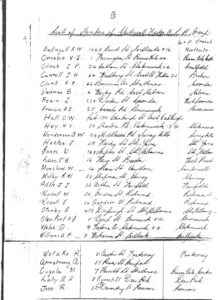
Dinny Lovegrove ALP Group leader in Victoria then sent a letter to all the Victorian industrial group secretaries asking for a list of their active members and which ALP branches they belonged to. The ETU group secretary Vin Crosbie provided an extensive list which included both the Union Secretary, Assistant Secretary and members of the executive. Crosbie listed twenty-eight members in all, some of which, according to John Pittle, were not or did not admit to being groupers. Feelings within the ETU were split down the middle with some, such as Snowy Henderson caught in the middle.
At the Melbourne ETU sub-branch meeting on 1 December, Messrs B Armstrong and N Pagonis put up a motion that, as the THC has declared the State ALP no longer worthy of support or financial assistance, the Union’s State Council should take steps to disaffiliate with the Victorian Branch of the ALP. Vin Crosbie, the President of the union ruled that the motion was out of order to which there was a motion of decent put forward from the Chairman’s ruling.
The Vice-Chairman took the chair, and after discussion over the President’s ruling, a vote against his ruling was taken and carried on the voices. A division was called for, and the President’s ruling was upheld by 27 votes to 24 votes.
On 8 December 1954, the ALP Federal Executive sent a circular to all affiliated unions, including the ETU, that spelt out the conditions for the Special Conference of the Victorian ALP to be held at Melbourne Trades Hall on 26-27 February 1955. The conditions included;
That the Federal Executive would supervise the conference which was to elect a new State Executive.
The rules were to be amended so that there was no requirement for the two years continuous membership for delegates to be eligible to attend the conference.
Affiliated unions were directed to hold new elections for their conference delegates.
The Federal Executive also made the following decisions with reference to Industrial Groups:
- That the Constitution covering A.L.P. Industrial Groups referred to on pages 101 and 102 of the current Constitution and Rules of the Victorian Branch shall be deemed to be non-existent after 31st December 1954.
(b) That it be agreed that this Executive shall submit a recommendation to the next Federal Conference in respect to the overall question of Industrial Groups organisation in Australia having particular regard for its original purpose of combating Communism in the Union and pending a determination by the Conference there shall be no recognition of this type of organisation by the Victorian Branch after 31st December 1954.
The ALP Federal Executive then called to disband the seven Victorian Union industrial groups. Those groups were the Electrical Trades Union, Ironworkers, Waterside workers, Clerks, Postal Workers, Tramway Employees, and Railway workers.
On the 9 December those seven Victorian industrial groups met at Trades Hall condemning the Federal Executive order as unconstitutional. They formulated a proposal that said, in part;
Through our own bitter experience gained in this struggle over a period of years we have become firmly convinced that Communism in the trade unions can be matched and defeated only by the strongly organised fighting body. The proposed withdrawal of Labor forces from the labour movement is tantamount to an expression of apathy towards the outcome of this struggle.
The following night, Vin Crosbie and the other delegates from those seven industrial groups fronted the Victorian ALP Central Executive protesting against the Federal Executive order to dissolve them. With the assistance of Dinny Lovegrove and others, the Central Executive adopted a proposal condemning the action of the Federal Executive. The proposal claimed the Groups were the only effective reply to organised Communist activities in the unions and expressed gratitude to Group members for their work.
By January 1955 all but two unions had disbanded their industrial groups. The Clerks’ union said it would be unwise to disband a group that had so successfully fought Communism in the unions while the ETU Secretary, Snowy Henderson said the disbandment could not take effect before the ALP Federal Conference appeal had been decided in February.
On 2 February the Melbourne Sub-Branch of the ETU held a meeting at which it was moved by Messrs Linn and Skews that the delegates must go to the Special Conference and give full support to the ALP Federal Executive.
A. P. Williams raised the question of electing new delegates to the Special Conference as suggested by the ALP Federal Executive. The Chairman of the meeting said that he would rule any such motion out of order as the delegates had already been elected at the last triennial elections.
Williams argued that they were elected to attend ordinary annual conferences of the ALP which were distinct from the Special Conference to be held at the direction of the Federal Executive.
A motion was put up that the Chairman’s ruling be upheld and was lost. This was followed by a motion put up by Messrs Skews and Sharp that a special meeting of the Victorian Branch of the ETU be held on 17 February to elect eight new delegates to attend the Special Conference. That motion was carried.
The State Secretary, Snowy Henderson pointed out that such a motion could not take effect until the State Council met on 23 February.
However, on 8 February the Branch held a Special State Council meeting to consider the sub-branch motion. The Chairman told the meeting that he’d instructed the Union Secretary to seek advice on the correctness of the Chairman’s ruling. The legal advice by the Maurice Blackburn legal firm was read out to the State Council.
The Chairman’s ruling was correct… the delegates elected at the 1954 triennial elections should be the delegates at the forthcoming special ALP conference…
…the branch of the union is affiliated to the Victorian Branch of the ALP and not to a conference –
The delegates elected at the last triennial elections have a legal right to attend Conferences –
…a new election at this point would be unauthorised under union rules –
…if the proposal put up involves a new election, the State Council cannot within the union rules, accept it –
…the State Council can instruct the delegates to support the ALP Federal Executive –
…the Chairman of the State Council ought to rule any proposal for a new election out of order –
…any special branch meetings called to put such a proposal for new elections, therefore, would be a futility.
Following the legal advice, the State Council decided that the already elected eight delegates should go to the conference and give their utmost support to the ALP Federal Executive.
The ETU Victorian Branch then sent the credentials of the eight delegates to the Acting Federal ALP Secretary, Mr J Schmella. They were R W Ballingall, J H Carrol, V J Crosbie, U Innes, A H Lahy, J J Pittle, A G Steinfort, and W Munslow and they duly attended the Victorian ALP Special Conference on 26 February 1955 as John Pittle remembered;
“…I didn’t think they were going to admit us, the ETU being grouper oriented because that meeting was set up to steer the party in that direction never mind about this direction. So, they were hand picking everyone that came in that door, and for years I’d been attending these meetings. In that meeting, once I was in it, there were a lot of strange faces I’d never seen before. A lot of strange faces.“
The outcome of the conference was that a new State Executive was elected, and the Industrial Groups were disowned by the Party.
However, it was not the end of it. The right wing of the Victorian ALP would not accept the outcome. As far as they were concerned, even though there was a new Victorian Executive, the old Executive was still in control. Four ministers and their supporters refused to accept the New Executive and were expelled from Premier Cain’s cabinet. Led by two Government Ministers, Les Coleman and Bill Barry they formed a breakaway faction crossing the floor and leaving Premier Cain without the numbers to govern.
This Coleman-Barry Group held secret meetings with the Liberal-Country Party and a vote of no confidence toppled the Cain Government. New elections would have to be called.
At the ETU Executive meeting on 14 April the Union Secretary produced a file of letters from both the old and new State ALP Executives requesting support and affiliation fees from the Union. The time had come to decide on the union policy. In other words which side the Union was to be on.
At the ETU State Council meeting on 27 April 1955 a recommendation from the Branch Executive was put to the meeting;
Having considered submissions from J V Stout and F McManus and the requests from both the old and new Executives for the payment of Affiliation fees and in the case of the old Executive that delegates should attend the Annual Conference commencing April 29 1955; this Executive deplores the present breach in the party which has already resulted in the defeat of the Victorian Labor Government and threatens the future of Labor throughout the Commonwealth …….
We realise that very strong differences of opinion exist within our ranks regarding charges and counter charges made by the respective Party groups.
We have previously refrained from comment in the hope that a unity conference might be convened but we are now reluctantly forced to the conclusion that this is not at present practicable and as this union has always recognised Federal authority in both industrial and political spheres, we resolve that recognition be given and affiliation fees be paid only to the Executive of the Victorian Branch of the ALP as elected at the Special Conference called by the Federal Executive on 26th February 1955.
As the body known as the “Old Executive” has been declared bogus, the ETU cannot take part in the conference on 29th April or give recognition to that body.
It is our desire that the Federal and state leaders and all rank-and-file members throughout the Commonwealth should support all efforts to re-unite ranks of Labor at the earliest possible date.
Messrs Hall and Gilpin moved a motion that the decision of the ETU to support the ALP New Executive be endorsed but it was countered by an amendment put by Messrs Pittle and Clinch that this union disaffiliate from the ALP.
The amendment to disaffiliate was put to State Council and lost. Then the motion to support the New Executive was put. Folklore has it that the vote was even with the deciding vote going to the Chairman, Vin Crosbie. That was until Jack Wells pulled back his brother-in-law, Bill Foster, saying, “Don’t be stupid!” and the vote to support the New ALP Executive was carried.
As the Government had fallen, the meeting then turned its attention to the upcoming election. A decision was made to support the Cain Government campaign with a donation of £200 to the Victorian Branch accredited by Federal Executive.
In the aftermath of the split and the anti-grouper declaration of the ETU Vic branch, Groupers and their sympathisers were no longer popular. The Union was clearly split down the middle.
At the State Council meeting of 1 August 1956 Vin Crosbie was nominated to become an organiser but others objected saying they would rather have no organiser than a Grouper. A vote it taken and Vin Crosbie as an organiser is lost sixteen votes to twenty-four.
Assistant Secretary Jock Innes went down to the Latrobe Valley as the
Yallourn sub-branch had voted in a new acting sub-branch secretary C. P. Brundell. Brundell is a grouper and Jock was not happy. In a letter, sent to Stan Cusworth, a member he trusted, saying;
Every trick in the pack will have to be pulled… If the position has to stand we will have to make an immediate start on a campaign to dislodge Brundell at the triennial elections… it makes me more determined than ever to go on with the job of cleansing the union of the influence of the C.A. gang.
That member had a greater loyalty to the Yallourn branch members and showed Jock’s letter to others who then approached the Union Executive;
We demand that comrade Innes be called upon to disprove these statements and in the event of his failing to do so that he be asked to resign his position as an executive officer.
In reply, Joc Innes made no apology for his intention to clear the union of the Catholic Action influence arguing that the DLP would stoop to any depths to gain control of important unions. The Executive considers and sums up that Jock no case to answer.
The 1959-60 triennial elections come around. Secretary Snowy Henderson nominated for the positions on the Federal Council and the Trades Hall Council, positions he had held for the previous twenty-five years. But a ticket was organised by Bob Ballingall, the Vice-President of the union that didn’t include the Union Secretary. Henderson saw this as a disloyal attempt to undermine his position, and he wrote an emotive flyer to the membership asking for their vote;
The most essential thing a chief executive officer is entitled to expect from his staff is loyalty and co-operation… You can imagine my feeling of amazement and disgust when a voting ticket appeared under the name of the Vice-President of the Branch and other Branch Officers, which eliminated me from those positions… I am and have been for more than thirty years, a member of the ALP… People who are circulating an alleged genuine Labor ticket with my name omitted are deliberately misleading members with a campaign of misrepresentation and lying slander reminiscent of the Fascist technique…
At the following sub-branch meeting, a motion was put up to censure the Union Secretary and demand an apology or his resignation. Henderson’s response was to agree to apologise for anything that was not true.
Snowy Henerson Secretary of the Union for forty-two years no longer had the support of a now socialist left Executive and he was forced to resign.
Vin Crosbie found himself ostracised within his union. No longer president he put himself up for the position of union Secretary in the triennial elections. He got no votes and left his union with bitter feelings.
The Vic Branch industrial group continued on after the split, as an almost underground organisation, and it did so without any union support. After Vin Crosbie’s fall from grace, John Pittle became its secretary. And while Jock Innes claimed to have put an end to the industrial group John Pittle had a different view saying that it just faded away as the support for the group dropped over the years.
Until the day he died John Pittle went into the office once a year and paid his union dues even though he became a one-man electrical contractor and never again held any official positions within his union. Vic Williams went on to become a member of its State Council and a respected voice of the union until the day he died.
References:
Books
Holt, Stephen; ‘Time to Dispel Industrial Group Myths’, in Michael Costa and Mark Hearn, (eds.); Reforming Australia’s Unions; 1997
McKinlay, Brian; A Century of Struggle : The A.L.P. A Century of History; Collins Dove; Blackburn, Victoria 3130; 1988
Murray, Robert; The Split : Australian Labor in the Fifties; Cheshire Publishing; St Kilda Road Melbourne, Victoria; 1970
Pattern of Deceit : The N.C.C. and the Labor Movement; published and produced by the Committee to Defend the Victorian A.L.P.
Purdham, Ken; A Century of Struggle : A History of the Electrical Trades Union of Australia, Victorian Branch; Hyland House Publishing; Flemington, Victoria 3031; 2002
Newspapers:
The Age, 1955
The Argus, 1955
Labor Call, 1950
Journals:
The Electrical Trades Journal 1947-54
ETU News 1955-60
ETU Victorian Branch Collection held at Melbourne University Archives;
ALP Dispute 1954-55; box 34
Minutes book; 1947; box 5
Minutes book 1954-55; box 6
Recorded interviews by Ken Purdham
Barney Cooney; ALP Senator for Melbourne; 1999
David Feeney; ALP Victorian Secretary; 1999
John Pittle; ETU member and Industrial Group Secretary; 1999
Keith Patterson & Phil Flarherty; ETU Members and State Councillors 1999
Vic Williams; ETU member and State Councillor; 1999