Cecil Sanders and Electromagnetic Radiation
My Dad Cecil Sanders and Electromagnetic Radiation
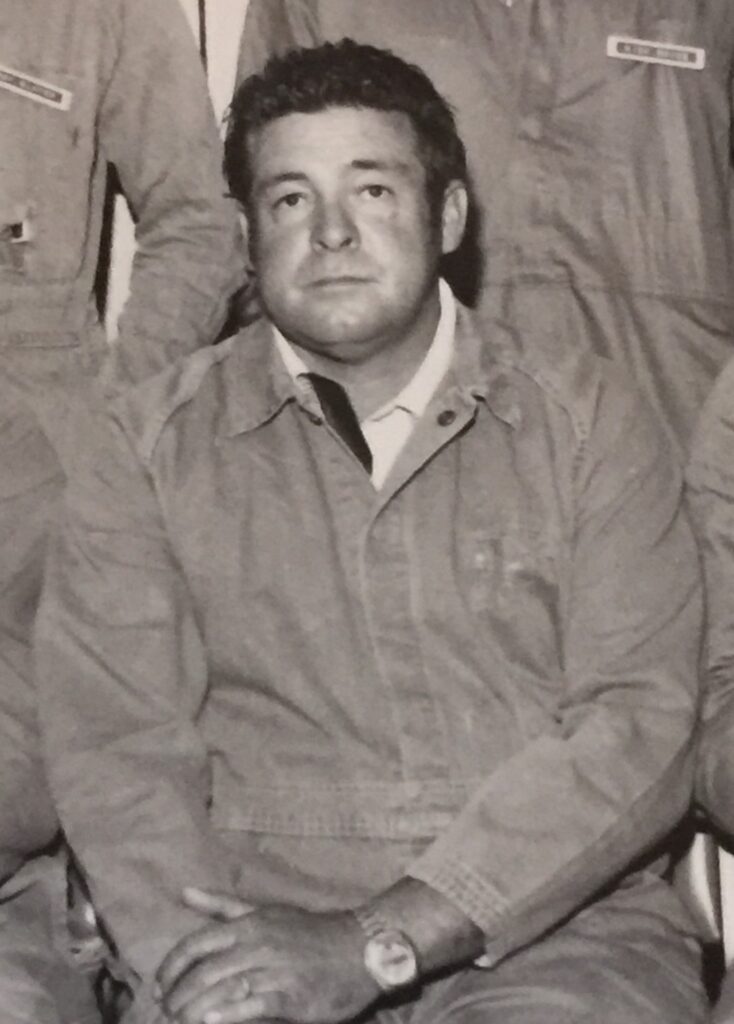
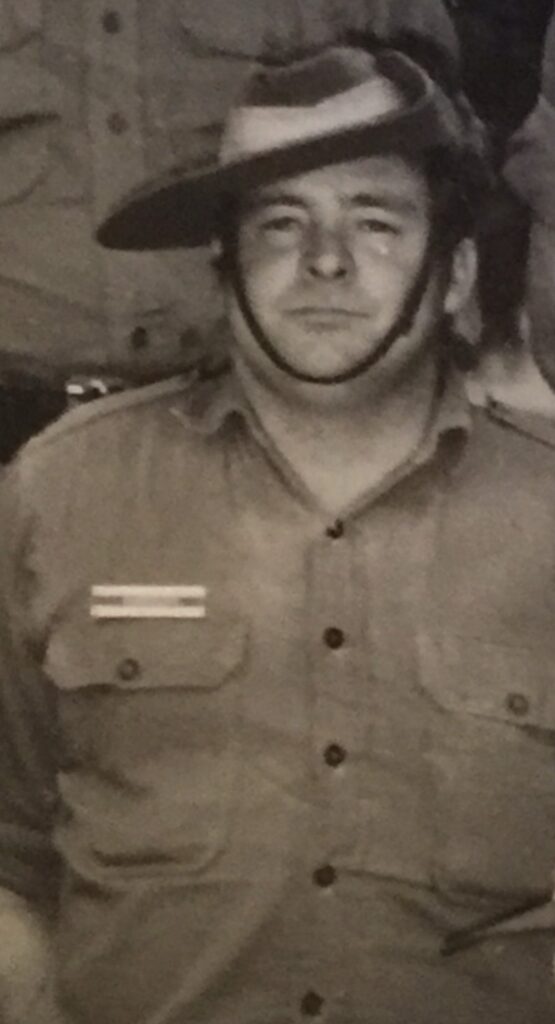
Cecil Sanders is remembered as a kind, caring person would help anyone. His daughter Kristina still remembers her father as someone who couldn’t go past a pub without having a drink. She remembers the smell of Old Spice after-shave, the Brylcreem in his hair, and a comb in his pocket. He was, to her, an Elvis Presley who had played footy for South Bendigo and had been an amateur boxer at some point. But there was so much more to Ces than his good looks, fine physique, and a willingness to help anyone who needed it.
Nicknamed ‘Furry’ by his mates, Cec had a hard upbringing. His mother passed away when he was eight years old, his dad was abusive, and his aunty raised him until he was fourteen. Then he ran away to join a circus, became a rodeo clown and found a love for motor bikes. Although Cec had many intimate conversations with his daughter, he spoke little of that time of his life; a time, it seems, he would rather not relive.
In 1962 he married, became an electrical linesman, and a member of a specialist unit of the Australian Defence Force reserves. Whenever he went off on an ADF operation it was using his skills as a linesman and his life revolved around those two aspects of his life.
Cec’s work and commitments with the ADF special conditions unit took him out of town for extended times. He was in 39 Electrical & Mechanical Engineers squadron based out of Newborough. And Kristina was her father’s daughter. When he came home he shared many stories with her and would save his army issued tubes of condensed milk as a sweet treat for her.
…In the mornings we’d always spend time together. About seven twenty-five, Dad’d be out on the veranda shining his boots. Typical ADF, rain, hail or shine Dad would walk to work or someone would pick him up on the way. My earliest memories, I would be always sitting beside Dad while he was shining his shoes, reading my reader. And that continued right up to the age of fourteen. Dad was illiterate. He couldn’t read or write. I think he left school in primary school. He didn’t talk about that. And I didn’t click until many years later that he was actually learning to read and write at the same time I was…
Cec also had a love of Holden cars. He was always working on them, always kept them immaculate and made sure his daughter was able to change a tyre, change an oil filter and change an air filter long before she was old enough to drive.
But he had his stern side too. As a linesman he worked on and around live, high voltage lines and because of the dangers the ‘live-linnies’ worked with, concentration and attention to safety detail had to be paramount. It explained to Kristina why her father could, at times, be so strict;
If you stuffed up with him you knew about it… they had a saying; ‘One flash and you’re ash!’…
Kristina remembers a time when, back in 1980, Cec was working with his gang on the Bendigo-Maryborough Road at Eastville. A line let go. As it flew, it lashed across the chest of linesman Jack O’Kelly who was fifteen meters up in the bucket of a cherry picker. The line dragged Jack out of the bucket and as he fell to the ground Cec Sanders, instinctively tried to break his fall. Jack died and Cec busted both his knees. In one of those intimate moments with Kristina he shared his turmoil. That moment, it seemed, wrapped around father-daughter like a security blanket.
I remember dad explaining to me how he tried to break his fall and he just felt he could have done more. He felt so guilty… Dad was a whistler… If he was at work or with me, he was happy and he would whistle. He didn’t whistle for months after that and I knew he wasn’t happy…
It wasn’t long after that accident that Kristina’s father began to feel unwell and there was a hint of foot drop in his step. A CAT scan revealed a tumour on the brain the size of a golf ball which was removed. Standing beside her father as a year eleven student, Kristina heard the surgeon say he’d removed 99.9% of it and it was benign. It was a great relief. The doctor said the tumour shouldn’t come back but even if it did, it was benign and it would be another ten years anyway.
Three weeks later Kristina looked down from her high school stage while being presented with an award. Her dad, head shaved but bright eyed, beamed with pride as he looked back at her. Holding her high distinction award for English she was thinking – this is for you Dad.
Three weeks more and Cecil Sanders was back at work, up the pole under the high-voltage again and back with his ADF unit. All was looking good.
The special conditions units of the ADF, Cec loved so much, were sponsored by various government departments and it was Cec’s employer, the State Electricity Commission that sponsored his unit. Once a year all units would muster for the purposes of building anything from bridges to helicopter pads, working long days in rugged terrain. And as Kristina remembers, the troops were always glad to come home for a few cold beers;
The camaraderie amongst the troops had a wonderful effect on my dad, and he made strong, lasting friendships… A few of the local SEC boys were fellow sappers in the unit and Friday evenings generally involved some yarn-swapping at the Lake View Hotel, which was his favourite watering hole for quite a while…
Although he seemed the Cec of old, he confided in his close mates that he wasn’t the same man. Then two years after the tumour had been removed it returned. This time it was so big it was going to strangle the main artery in the brain which would risk death or him becoming a quadriplegic. Back in hospital Cec had CAT scan after CAT scan and when it became the only alternative, they operated.
He came through but was paralysed down one side and partially paralysed down the other. After the operation and on a cold and windy night, on 18 June 1984, Kristina went to see her dad in the hospital.
The hardest day of my life was going down and seeing Dad after that operation… and he begged me to go home and get one of his guns and bring it back to the hospital loaded. He never forgave me after that…
Kristina was now a nineteen-year-old trainee nurse and was able to access to her father’s file. She read that Cec died in the operating theatre, and they had brought him back. She thought maybe it would have been better if they hadn’t.
Even so, Cec completed months rehab before returning home. He was determined to get to a point of returning to work in some way. If he was going to be disabled from age 45 then he wanted to be able to drive for the SEC and check lines from a car. Kristina took her dad for every treatment that she could think of including acupuncture. But, because of seizures, his driver’s license was taken from him along with any chance of returning to work. Kristina remembers;
After all of this we would just the two of us go on road trips to Kerang, Swan Hill and other local areas; me driving and dad would just look out the window following all the power lines and reconstruction of the Myers Flat towers after a tornado came through in the early 1980s.
Kristina was to become his primary carer, assisting him from room to room and toileting him; but at least he was with family.
Beyond family caring, the Electrical Trades Union sub-branch Secretary and Cec’s friend, Peter Allan, was troubled. What could his union do for Ces? Peter had heard of regional union organiser, Graeme Watson’s investigations into the new science of Electromagnetic Radiation (EMR) and the effects it could have on those working in the vicinity of it. His thoughts were could the tumours have anything to do with the exposure Cec and his ‘live-linnie’ mates are subjected to every day of their working lives. Kristina remembers some of its effects;
…Dad said you could feel it… and honestly even when he came home from work, cause sometimes I’d go and cuddle him and I’d almost get a kick-back from him and I thought it was in my imagination. And I mean the amount of times he would zap me when he touched me, it was like are you going around shuffling your feet on the carpet – that’s what I thought. But it was the static he was carrying.
Graeme and Peter began to run the notion, within union circles, that after overcoming the first tumour Cec was back up the poles being exposed to HV and maybe it was the effects of EMR that had brought it back. They wanted to link the effects of EMR to Cec’s second tumour, at least. If so, this could happen to other live-linnies. The union, however, had no policies on EMR and so, as well as what could be done for Cecil Sanders, this was about looking to develop of a policy of safe work practices for all line workers.
Peter went to see Cec to say they were investigating the likelihood that EMR could have contributed to his tumours. Cec’s wife answered the door and as Peter tried to say that maybe there could be a chance of a compensation claim, she said, ‘Do what you like,’ and shut the door in his face. So, in August 1984 and after discussions with his union leader, Graeme Watson contacted the lawyers about preparing a compensation claim for Ces.
Graeme also knew the ABC 4Corners investigative reporter Kerrie O’brien from their association in the ALP and he put the Cecil Sanders story to him. The response was if the union could produce enough evidence to justify a program, it would be considered.
Back at home Cec had begun to have constantseizures or mini strokes, and they were unpredictable. Many times, the ambulance would be called, he would go into hospital where nothing could be done and he would return home again. It became too hard to care for him and so, at the age of forty-six, he was placed in the Bendigo Home and Hospital for the aged.
Peter and Graeme went to see Cec in the Home and suggested the possible link between being exposed to EMR and his tumours. They told him while the union had no policies on it, they wanted to look after his interests and to progress this to try to develop something to protect others from the chances of EMR affecting them. He agreed to allow them to continue to investigate, and the outcome was an ABC 4Corners program.
In May 1985 investigative journalist, Kerry O’Brien sat with Cec and asked in part;
KO: Did anybody within the commission ever mention the term electromagnetic radiation?
CS: No, none whatsoever.
KO: So, you didn’t know what EMR was?
CS: No, wouldn’t have a clue.
Kristina was concerned about her father’s cognitive abilities and didn’t think Cec understood, all together, what was happening but by then he was past caring anyway.
KO: So very soon after the first operation you’d recovered enough to be able to go back onto the high voltage wires?
CS: Yeah, I didn’t say anything to anybody, nobody said anything to me so I up and into it again; of course, this is the way it left me the second time.
The SEC, Cec’s employer, wanted nothing to do with the link between EMR and possible links to cancer. It flatly refused to accept that tumours growing in Cecil Sanders had anything to do with his work as a ‘live-linnie’. And it went so far as to attempt to stop a second 4Corners program from going to air, being accused, in the media, of using standover tactics towards the ABC producers.
From its inception, the SEC had sponsored the special conditions unit Cec belonged to. However, ironically, in his hour of need, it seems it was prepared to turn its back on him and those other ‘live-linnies’ who worked in the vicinity of high voltage power lines that could be subjecting them to EMR.
When Kristina sought support from the surgeon, she argued that even if EMR didn’t cause the tumours it at least fed them. The surgeon also wanted nothing to do with the argument about the effects of EMR and refused to offer any opinions.
All in all, though, none of this could stop the cancerous tumours from eating away at the life of Cecil Sanders and he was to spend the last four years of his life in the Bendigo Home and Hospital for the Aged with Kristina visiting him and taking him back to her own home for visits.
As time passed, Kristina was to have two children and, at least, Cec got to meet and hold his first grandson. But as Grandad looked at grandson, all Kristina could see in her father’s face was sadness. It was as if he was thinking, I’m not going to see him grow up. Cec’s condition deteriorated quickly to a point that he wasn’t able to acknowledge his granddaughter when she came along.
But even with two children in tow, Kristina continued to sit with her dad knowing the end of his life was getting closer and closer. In the evening of 9 April1990 Cec’s wife and siblings came to spend some time with him. After they left, Kristina, again, sat with her dad as they had done so many times throughout her life. She’d watched him polish his shoes, he’d zapped her when she tried to hug him, and he’d confided in her over his attempt to save the life of Jack O’Kelly. If ever that security blanket that surrounded their relationship was needed, it was now.
Cec was restless. Kristina got up from his bedside, walked to the window and looked out at the lights of the city of Bendigo. It was close to eleven o’clock at night;
…I was just standing there looking out of the window and then he groaned and just said, ‘Help me.’
Kristina went back to his bedside, tended to her dad and knew the moment had come;
…he passed away about ten minutes later and I just sat there with him for about fifteen minutes and then, because it was about a quarter to twelve and I thought we’re going to get dates wrong here, I went down and got the unit manager and said Dad’s passed…
Dad’s work, family values and love for me were so strong, something I haven’t experienced since. He was a very special man of integrity, selfless and compassionate, caring to anyone that his path would cross. And to this day he guides me. I miss, every day, that grounding my dad gave me and making sure that I didn’t become a self-entitled person.
Although the fight for the life of Cecil Sanders was over, the fight continued, in his name, for all other ‘live-linnies’ exposed to EMR.
A Victorian ETU Branch policy resulted, followed by a National Policy on Electromagnetic Radiation and a targeted upgrade of the legislated Victorian electromagnetic radiation High Voltage Safety Standards. Those standards are known to linemen as ‘The Blue Book’.
And even now, as the science is still being debated, it can be said, in Cecil sanders memory, that a heightened knowledge on the human effects of EMR exposure on Live Linnies and other electrical workers prevails.